ÉDITIONS TILA · 2026
The book
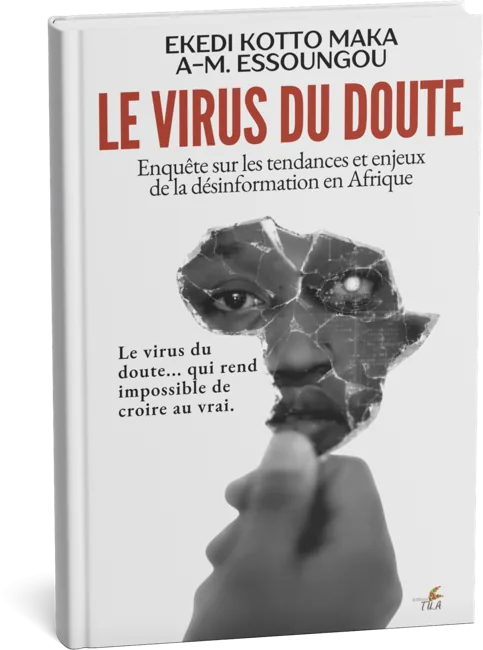
A narrative investigation into disinformation in Africa, by Ekedi Kotto Maka and André-Michel Essoungou.
The book examines how information is manipulated across African societies — and how journalists, local communities and researchers respond. It connects political influence, digital platforms, electoral contests and the struggle to rebuild trust.
Available in French. An English edition is coming soon; no publication date has been announced here. English chapter titles on this site are descriptive translations.
ISBN 9798195140540 · 126 pages
Éditions Tila · 417 rue des Cocotiers, Bonanjo, Douala
CONTENTS
Five chapters, one investigation
Page numbers below refer to the printed French edition.
Reader’s note · p. vii
Two paths — one a journalist who moved from the BBC and RFI to the UN, the other a digital strategist — and one method: an investigative narrative whose sources are gathered chapter by chapter at the end, “because verification is precisely the subject of this book”. Read free · PDF 75 KB
Prologue · p. 1
From a fake rupture between Kigali and Washington to the streets of Niamey in July 2023: an overview of the trends, actors and responses — Cambridge Analytica, Team Jorge and deepfakes, but also Africa Check and community radio in Burkina Faso. Read free · PDF 143 KB
1. Digital word of mouth · p. 13
Footage filmed in Saint-Étienne in 2021 becomes, in 2023, “proof” of a murder in Tunisia. From colonial radio and the Muldergate scandal to WhatsApp as the new rumour mill, the chapter shows how disinformation adapts to orality, digital and language divides, and wounded memories — down to vaccine mistrust in Douala and Kano. Read free · PDF 202 KB
2. Africa’s information warriors · p. 29
In Bamako, the videomen linked to the Yèrèwolo movement — digital heirs to the griots — produce more than ten times as much content as the movement they support. In South Africa and Kenya, political influence has become a profession, bought by the hashtag and the like. Africans appear here as actors, not mere relays.
3. The influence mercenaries · p. 47
Cambridge Analytica in Kenya and Nigeria before Brexit, Team Jorge and its avatars, the Archimedes Group, French and Russian fake accounts clashing in the Central African Republic, then China, Turkey, the UAE and Iran — and the arrival of deepfakes, from Kenya to South Africa.
4. The law as a weapon · p. 57
Ignace Sossou jailed over three tweets, Benin’s Digital Code, internet shutdowns in Ethiopia, Nigeria’s Twitter suspension, Uganda’s social media tax: when the fight against “fake news” also becomes a way to control information.
5. Reclaiming the narrative · p. 67
Africa Check’s voice notes, FasoCheck in Mooré, Fulfulde, Dioula and Gourmanchéma, radio theatre in Ouahigouya, griots turned fact-checkers, African language models and new African Union frameworks: the responses the continent is inventing — and their fragilities.
Epilogue · p. 79
From WhatsApp groups in Niamey to community radio in Burkina Faso, the journey’s conclusions and a conviction: information sovereignty is won “story by story, language by language, voice by voice”. Read free · PDF 61 KB
References · 81 / Bibliography · 107 / About the authors · 113
Academic access, by request
The full book is not available as a free download, but its opening pages are, in the Excerpts section. Teachers, students and researchers may request a free copy for academic purposes. Please explain your institution and intended use; the publisher will respond to your request.
Request academic access Read the free excerpts